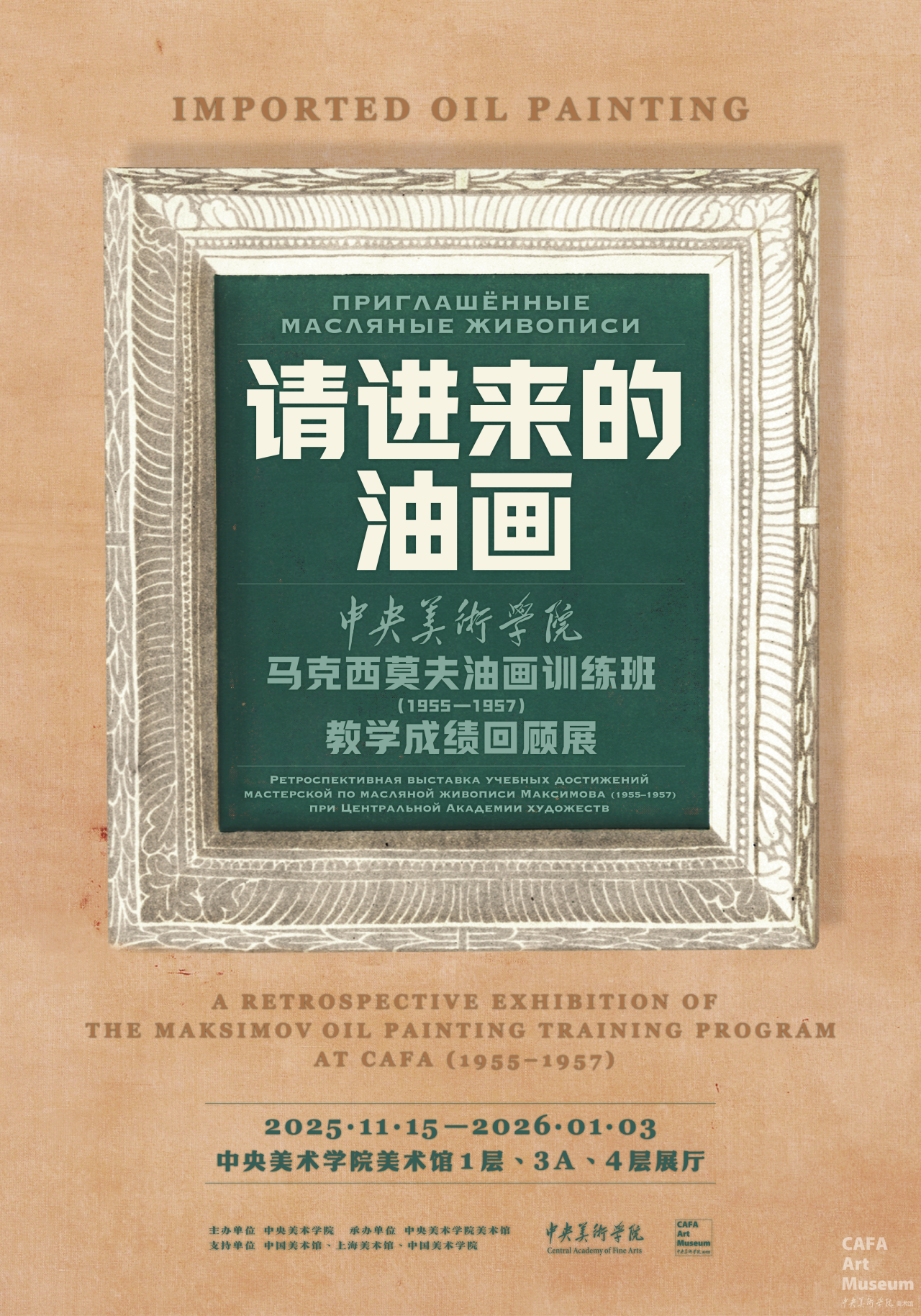
Imported Oil Painting-A Retrospective Exhibition Of The Maksimov Oil Painting Program At CAFA

  • Dates:2025-11-15 - 2026-01-03
  • Location:中央美术学院美术馆 1层/3A/4层展厅
  • Opening:
  • Organizer: Central Academy of Fine Arts
  • undertaker: CAFA Art Museum
  • General Counsel: Xu Yang
  • Academic host: Lin Mao
  • Overall coordination and guidance: Wang Xiaolin, Lü Pinjing, Wu Qiang, Pan Chenghui
  • curator: Jin Jun Cao Qinghui
  • Planning Director: Han Wenchao
  • Curatorial hosting: Gaogao Navy
  • Curatorial execution: Li Yaochen Wang Jing
  • Design Director: Ji Yujie
  • Acknowledgements: Chen Beixin, Jin Shangyi, Gu Ancun, Feng Shiguang, Gao Tianxiong, Cai Guoqiang, Chen He, Hou Shanhu, Lin Lin, Luo Qunyi, Ren Hui, Song Xianzhen, Tian Xiaodong, Wang Xueqing, Wei Xingtao, Wu Xiaochuan, Wu Yongfan, Xu Dihua, Yang Yi, Zhang Fan, Zhan Ying, Maoyuan Hongzhai Culture, Chongqing Chinese Contemporary Art Museum

Artworks

Artworks

Photographs

Photographs

Related essays

请进来的油画——中央美术学院马克西莫夫油画训练班(1955-1957)教学成绩回顾展 即将亮相!

2025-11-13

请进来的油画中央美术学院马克西莫夫油画训练班(1955-1957)教学成绩回顾展展览时间: 2025年11月15日—2026年1月3日展览地点: 中央美术学院美术馆1层/3A/4层展厅主办单位:中央美术学院承办单位:中央美术学院美术馆作为20世纪中国油画发展历程中的重要篇章,马克西莫夫油画训练班(1955-1957)为中国油画艺术培养了一大批杰出人才,有力推动了油画艺术在中国的传播与发展,其影响深远,绵延至今。马克西莫夫在中国(中央美术学院档案室存)2025年恰逢“马克西莫夫油画训练班”开班70周年,为系统梳理并全面呈现这一历史事件的教学成果与学术价值,中央美术学院美术馆将于2025年11月15日至2026年1月3日举办“马克西莫夫油画训练班(1955-1957)教学成绩回顾展”。此次展览通过270余幅作品、100余幅文献与历史资料有机结合的展示,重现那段充满理想与探索精神的艺术岁月,彰显其历久弥新的文化意义。1955年油画训练班在京郊农村作外光作业1955年,油画训练班学员下乡出发 (靳尚谊存)1955年底,马克西莫夫在指导作品(中央美术学院档案室存)康斯坦丁·麦法琪叶维奇·马克西莫夫(K.M.Максимов,1913-1993)1955年至1957年期间作为当时文化部特邀顾问,在中央美术学院设立油画培训班(简称“马训班”或“油训班”),自1955年4月5日开班,至1957年7月结业,期间共有21名学员入学,19名学员正式结业。所教授课程由马克西莫夫根据彼时苏联美术教育经验进行组织,从结构、外光等油画基础启蒙到表现现实生活和情感的主题油画创作。两年多的努力之下,学员创作面貌焕然一新,诞生了冯法祀《刘胡兰就义》、侯一民《青年地下工作者》、詹建俊《起家》、靳尚谊《登上慕士塔格峰》等一批影响广泛的毕业创作,标记了以人为本的现实主义油画创作在新中国发生发展的成果,既是中央美术学院油画教学的动人篇章,也是中国现代油画发展的关键一环。1957年,马老师在课上看汪诚一的毕业创作《信》(汪诚一存)1957年,毕业旅行写生途中在船上观摩马克西莫夫写生(中央美术学院档案室存)此次展览将以务求完整的宗旨,全面回顾“马训班”为期2年半的过程中师生教与学的历程和创作的成果,以此关照现实主义油画如何在新中国高等美术教育和创作领域迈开第一步,在新时代百舸争流之际,追溯中国油画的现实主义表达的源流,希望能够对深入思考中国油画创作与教学的当下问题与未来可能有所助益。马克西莫夫 风景  69×49cm 布面油彩 1957年 中央美术学院美术馆藏侯一民 地下工作者  210×176cm 布面油彩 1957年 中央美术学院美术馆藏詹建俊 起家 140×348cm 布面油彩 1957年 中央美术学院美术馆藏靳尚谊 登上慕士塔格峰 180×270cm 布面油彩 1957年魏传义 油画速写(出海) 49×65cm 布面油彩 1955年 中央美术学院美术馆藏汪诚一 远方来信 144×228cm 布面油彩 1957年 中央美术学院美术馆藏袁浩 长江黎明 154×283cm 布面油彩 1957年 中央美术学院美术馆藏任梦璋 摘苹果(三联之一) 120×75cm 布面油彩 1957年 中央美术学院美术馆藏 任梦璋 摘苹果(三联之二) 120×75cm 布面油彩 1957年 中央美术学院美术馆藏任梦璋 摘苹果(三联之三) 120×115.5cm 布面油彩 1957年 中央美术学院美术馆藏靳尚谊 拄棍的老人王大爷  76.1×61.3cm 纸上铅笔 1955年 中央美术学院美术馆藏何孔德 人物侧面(局部)  17.7x12.4cm 1955年 何孔德  速写 17.7x12.4cm 1955年请进来的油画——中央美术学院马克西莫夫油画训练班(1955-1957)教学成绩回顾展展览时间: 2025年11月15日—2026年1月3日展览地点: 中央美术学院美术馆 1层/3A/4层展厅主办单位:中央美术学院承办单位:中央美术学院美术馆总顾问:徐扬学术主持:林茂统筹指导:王晓琳 吕品晶 吴强 潘承辉策展人:靳军 曹庆晖策划总监:韩文超策展主持:高高 海军策展执行:李垚辰 王静设计总监:纪玉洁鸣谢:谌北新、靳尚谊、古安村、冯世光、高天雄、蔡国强、谌河、侯珊瑚、林琳、罗群毅、任绘、宋贤珍、田晓东、王雪青、魏星涛、武小川、武永凡、徐涤华、杨毅、张帆、詹滢、懋源泓斋文化、重庆华人当代美术馆主编 / 何一沙责编 / 杜隐珠现场图 / 张书豪
More

影响中国油画半个多世纪的“马训班” ,你了解多少?

2025-11-20

作为20世纪中国油画发展历程中的重要篇章,马克西莫夫油画训练班(1955-1957)为中国油画艺术培养了一大批杰出人才,有力推动了油画艺术在中国的传播与发展,其影响深远,绵延至今。2025年恰逢“马克西莫夫油画训练班”开班70周年,为系统梳理并全面呈现这一历史事件的教学成果与学术价值,中央美术学院美术馆于2025年11月15日至2026年1月3日举办“请进来的油画——马克西莫夫油画训练班(1955-1957)教学成绩回顾展”,并于11月21日上午10:00举行开幕式。这场展览将带领观众了解那个重塑油画语言的关键时期——在这里,270余幅作品、100余幅图片、文献与历史资料有机结合的展示,让你能够看到苏联油画技法与中国本土审美首次深度碰撞的珍贵手稿,触摸到艺术家们突破传统、探索现实主义新路径的创作温度,更能读懂为何这个仅有数十人的培训班,能成为此后数十年中国油画教育与创作的“源头活水”。
More

Imported Oil Painting | The Grand Opening of A Retrospective Exhibition Of The Maksimov Oil Painting Training Program At CAFA(1955-1957)

2025-11-23

On November 21st, the opening ceremony of the exhibition "Imported Oil Painting -- A Retrospective Exhibition Of The Maksimov Oil Painting Training Program" was grandly held at the CAFA Art Museum. Hosted by the Central Academy of Fine Arts, this exhibition is co-organized by CAFA Art Museum and the China-Russia Art Exchange Center of CAFA, with support from the National Art Museum of China, Shanghai Art Museum, and China Academy of Art. The exhibition brings together more than 240 works created during the "Maksimov Training Class" period, along with a wealth of documentary materials, historical photos, and over a hundred publications, comprehensively presenting the teaching achievements of the Maksimov Oil Painting Training Class.Looking back at the history of Chinese art education and the history of art academies, seventy years ago, the launch of the Maksimov Oil Painting Training Class marked the beginning of an important chapter in the development of Chinese oil painting in the 20th century, nurturing a large number of outstanding talents for Chinese oil painting art. Today, seventy years later, the Central Academy of Fine Arts reviews this historical journey through an exhibition. This is not only a tribute to history, but also a practice of artistic inheritance. The exhibition bears a profound yet unadorned name – "Teaching Achievements Report Exhibition". However, these few words go beyond the scope of an oil painting exhibition or a documentary exhibition; they represent the finest review of that period of history, as well as the history of Chinese art education and the development history of oil painting education.Present at the opening ceremony were: artists and educators from the Central Academy of Fine Arts: Jin Shangyi, Sun Jingbo, Dai Shihe, Chen Weihe, Ren Shimin, Gao Tianxiong, Ding Yilin, Ma Lu, Liu Bo, and Jin Rilong. Lin Mao, president of CAFA; Pan Chenghui, assistant to the president of CAFA; Daria Kuznetsova,director of the Beijing Russian cultural center and counselor of the embassy of the russian federation in China; Han Xuemei, chief consultant of the Beijing Russian cultural center, and Vasily Kukosa distinguished artist of the russian federation. Other guests: Wang Zhong, Former Editor-in-Chief of Art Magazine; Yang Feiyun, Honorary Dean of the Oil Painting Academy of the Chinese National Academy of Arts; An Yuanyuan, Former Secretary of the Party Committee of the National Art Museum of China; Hu Yanyan, Director and President of China Guardian Auctions Co., Ltd.; Wang Yuan, Editor-in-Chief of People's Fine Arts Publishing House; Lin Hong, Vice President of Li Keran Art Academy; Liu Mingcai, Vice Dean of the School of Arts, Renmin University of China; Fu Jun, Director of the Art Museum of Shanghai Oil Painting and Sculpture Institute; Zhang Shuguang, Secretary-General of the Chinese Oil Painting Society and Professor of Minzu University of China; Xiao Ge, Editor-in-Chief of Phoenix Art and Director of the Phoenix Center; Ouyang Xing, Director of Shijingshan Zhongchong Art Museum; Exhibition organizers from CAFA: Jin Jun, curator of this exhibition and director of the CAFA art museum; Cao Qinghui, professor of the school of humanities, CAFA; Han Wenchao, exhibition planning director and secretary of the directly affiliated party branch of the CAFA art museum;family representatives of the Maksimov oil painting training class alumni: Feng Shiguang, family member of Feng Fasi, former monitor of the training class; Wang Xueqing, family member of Wang Dewei; Ren Ping, Ren Menghu, Ren Mengxiong, Xie Ying, Zhu Shaofang, Zhang Yingxue, Ren Mengqiang, family members of Ren Mengzhang; Song Hong,  family member of Wang Chengyi, Yu Li, family member of Yu Yunjie; Gao Tianxiong, family member of Gao Hong; Chen He, family member of Chen Beixin; Wu Yongfan, family member of Wu Dezu; as well as representatives from social organizations, collection institutions, and collectors; media representatives; and heads of various teaching departments, research institutions, and administrative departments of CAFA. Yu Yang, director of the research department of CAFA, served as the host of the opening ceremony.Speech by Lin Mao, President of the Central Academy of Fine ArtsIn his speech, Lin Mao, President of the Central Academy of Fine Arts, stated that the grand opening of this exhibition aims to commemorate the 70th anniversary of the launch of the Maximov Oil Painting Training Class—a pivotal moment in the history of China’s modern fine arts education. In the 1950s, when the People’s Republic of China was striving to rebuild and develop after years of upheaval, the Ministry of Culture adopted the "bringing-in" initiative to invite Soviet expert Konstantin Maximov to China to teach. In 1955, Maximov established an oil painting training class at CAFA, where he systematically introduced the modeling system and teaching methods of Soviet realistic oil painting. This program nurtured a group of artists and educators who would later become the backbone of Chinese fine arts, including Jin Shangyi, Zhan Jianjun, and Hou Yimin. Their achievements laid a profound and solid foundation for the establishment of China’s modern fine arts education system.Every study and artwork on display is not only a trace of art, but also an imprint of the era. They record the exploration process of that generation of artists, who integrated oil painting techniques with Chinese reality and national spirit. The teaching philosophy advocated by the Maximov Training Class—"valuing life drawing, orienting to real life, and attaching equal importance to technical skills and artistic cultivation"—has been deeply integrated into CAFA’s academic tradition and continues to influence the development of Chinese oil painting. Against the backdrop of the new era, the Central Academy of Fine Arts will keep in mind General Secretary Xi Jinping’s instruction to "uphold moral education and cultivate people, root in the life of the times, and carry forward the spirit of Chinese aesthetic education". It will fulfill its mission of nurturing students with a great love for education and creating timeless works with superb artistic skills, while adhering to upholding fundamental principles and breaking new ground, and advancing with the times. In doing so, CAFA aims to cultivate more and more outstanding high-end artistic talents for Chinese fine arts in the new era.Speech by Jin Shangyi, Former President of the Central Academy of Fine Arts and Representative of the students of the Maximov Oil Painting Training ClassJin Shangyi, former President of the Central Academy of Fine Arts and representative of the students from the Maximov Oil Painting Training Class, shared the special significance of the "Maximov Class" from the perspective of a first-hand witness, focusing on two aspects: historical review and contemporary reflection. He recalled the reality of China’s underdeveloped economy and culture, as well as the weak foundation of oil painting in the early days of the People’s Republic of China. He emphasized that against the backdrop of "Sino-Soviet friendship" at that time, Soviet experts assisted China in establishing teaching systems such as the "Oil Painting Training Class," which provided enormous support for the initial development of China’s literary and artistic undertakings. He also referred to the 1950s and 1960s as the "golden age" of China’s rapid artistic development. Building on this, he shifted his focus to the present, pointing out that the world has undergone tremendous changes in the past seventy years, and the thinking and creative environment of current oil painting students are completely different from those of the past. Taking this exhibition as an opportunity, he put forward a core topic: after reviewing history, we must address the practical and crucial question of how Chinese oil painting should develop in the contemporary era. He inspired everyone to compare the past and the present, and jointly explore the path forward.Dana Vasilieva, Counselor of the Embassy of the Russian Federation in the People's Republic of China and Director of the Beijing Russian Cultural CenterOn behalf of the Russian Cultural Center, Dana Vasilieva, counselor of the embassy of the Russian Federation in the People's Republic of China and director of the Beijing Russian Cultural Center, congratulated the successful launch of the events marking the 70th anniversary of the Maximov Oil Painting Training Class and the China-Russia Year of Cultural Exchange. She spoke highly of Professor Maximov’s historic contributions, noting that the master artists he nurtured not only laid the foundation for China’s oil painting education system, but also built an enduring bridge for artistic exchanges between China and Russia. She mentioned the scale of the exhibits in this exhibition, emphasizing that these works are not only artistic teaching materials, but also a testament to China-Russia friendship. She pointed out that the "Maximov Class" symbolizes the successful practice of Russian fine arts education in China and embodies the two countries’ shared pursuit of beauty. This exhibition is not only a heartfelt look back at history, but also a new starting point for future cooperation. The Russian Cultural Center will, as always, support in-depth cooperation between art institutions of the two countries, enabling the movement of China-Russia cultural exchanges to play a more touching melody in the new era.Speech by Feng Shiguang, Son of Feng Fasi Feng Shiguang, the son of Feng Fasi who served as the monitor of Maximov's Oil Painting Training Class, looked back on the history of how Professor Maximov systematically introduced the Russian-Soviet oil painting system to China 70 years ago. He pointed out that the "Maximov Class" was a successful example of the strategy of "going out and bringing in". Its teaching achievements have become the mainstream system of Chinese oil painting education and a milestone in its development. As a descendant, he emotionally recalled the profound friendship forged between the older generation during that period, and expressed his hope that future generations would carry on this friendship. Finally, he emphasized that the educational experience of the Maximov Training Class remains an indispensable system to this day. He also spoke highly of the current exhibition, stating that it is not merely a commemoration, but more importantly, an objective and calm sorting out and summary of history. He further noted that the exhibition holds historical and academic significance equally important to the inauguration of the "Maximov Class" back in the day.Speech by Cao Qinghui, Professor at the School of Humanities, Central Academy of Fine Arts, and curator of this exhibitionFrom the perspective of the curatorial team, Professor Cao Qinghui—who is from the School of Humanities at the Central Academy of Fine Arts and serves as the curator of this exhibition—delivered an in-depth elaboration on the motivation, positioning, and specific concepts behind the organization of this exhibition. There are three inherent driving forces for this exhibition: First, the accumulation of collections related to the "Maximov Class" by the CAFA Art Museum over the past decade during its collection inventory work; second, the solid achievements that have been made in academic research on this training class; third, the clear sense of inheritance responsibility held by the curatorial team. Based on these, the exhibition is clearly defined as a "Retrospective of Teaching Achievements" that focuses on the teaching process itself from 1955 to 1957, aiming to trace back how the students "learned, what they learned, and how they improved and created." To this end, the curatorial team made a special effort to collect and exhibit a large number of the students’ daily studies, sketch drafts, and other works, rather than just their well-known graduation creations—with the expectation of presenting a comprehensive picture of the training class’s teaching.He pointed out that the core contribution of the "Maximov Class" lies in its "method": it solved the problem of how ideological concepts could be translated into specific oil painting technical expressions, making it an "advanced course on oil painting methods." This teaching model, which centers on creation, emphasizes artists’ sense of responsibility and technical methods, and goes beyond illustrative expression, has exerted a profound and far-reaching influence.Speech by Wang Zhong, Former Editor-in-Chief of Art MagazineWang Zhong, former Editor-in-Chief of Art Magazine, shared precious memories related to the "Maximov Training Class" . As a child of a CAFA family, he personally witnessed how artists like Mr. Feng Fasi created works in line with the principle of "being loyal to life and loyal to life drawing"—a principle emphasized by Maximov. Taking the painting Liu Hulan’s Martyrdom as an example, he vividly described details such as how the artist meticulously collected materials, drew sketches, and even used salt as a substitute for snow in the creative process. These details demonstrated the solid and rigorous creative style of artists of that generation.He echoed Mr. Jin Shangyi’s view, stating that the practical significance of this exhibition lies in inspiring reflections on contemporary issues in Chinese oil painting. He proposed that the core issues of oil painting art ultimately boil down to basic elements such as form, color, and composition, and expressed the hope that this exhibition would provide a positive impetus for contemporary creative practice.Yu Yang, director of the research department of the central academy of fine arts, served as the host of the opening ceremonyNotably, during the preparation of the exhibition, the family members of Mr. Yu Yunjie provided great support and donated Mr. Yu’s representative works. This not only enriches the collection sequence of the art museum, but also provides precious material evidence for subsequent academic research. Their generous act and original aspiration for art are the best response to the inheritance spirit embodied in this exhibition. It is also hoped that this can gather more artistic strength and promote the passing down of the legacy of Chinese oil painting.Jin Jun, director of the CAFA Art Museum, presented a donation certificate to Mr. Yu Li, son of Yu Yunjie the donor of the artworksgroup photo of the guestsThis exhibition is divided into three sections, with the first section located in the lobby on the first floor of the art museum. Within a specially designed scenic space, this section centers on historical materials such as historical photos, documents, and archival texts, tracing back the learning journey of the Maximov Class.The second section is situated in Gallery 3A of the art museum. As the highlight and core of the exhibition, it consists of two parts—"Maximov in China" and "Graduation Creations and Manuscripts of the Maximov Class"—offering an in-depth look into the learning days of the Maximov Class. Through the collaborative efforts of all parties involved, the exhibition has finally brought together over 120 works from the Maximov Class era, including some pieces that were exhibited in Maximov’s 1957 personal exhibition, as well as graduation creations and manuscripts by the training class students. After nearly 70 years, these works are being displayed again in this retrospective exhibition, creating an atmosphere akin to a "reappearance of history."The third section is located in the exhibition hall on the 4th floor of the art museum. Comprising three segments—"Indoor Life Drawing in the U-Shaped Building," "Outdoor Life Drawing in the Sunlight of Beijing’s Suburbs," and "Life Drawing During Graduation Trips"—this section gathers more than 120 basic teaching assignments and outdoor life drawing studies created during the Maximov Class period. These works reflect the growth and achievements of the students, who received systematic foundational art education enlightenment—covering structure, outdoor light, composition, and even painterliness—under Maximov’s guidance.This exhibition will run until January 3, 2026. We look forward to welcoming visitors to join us in stepping into the "time tunnel" of this 70-year historical context and exploring the foundational years of China’s modern oil painting education!Maximov in China (housed in the archives of the Central Academy of Fine Arts)In 1955, the Oil Painting Training Class conducted outdoor light painting exercises in the rural areas on the outskirts of BeijingIn 1955, the students of the Oil Painting Training Class set off for the countryside (Preserved by Jin Shangyi)In 1957, Teacher Ma reviewed Wang Chengyi's graduation work Letter during class (Preserved by Wang Chengyi)Konstantin MaximovGirl in a Purple Sweater Oil on Canvas, 73×54cm, 1956, Collection of Cai GuoqiangHou Yimin, Underground Worker  Oil on Canvas, 210×176cm, 1957, Collection of CAFA Art MuseumZhan Jianjun Starting Out Oil on Canvas, 140×348cm, 1957 Collection of CAFA Art MuseumJin Shangyi Climbing Mount Muztagh Ata Oil on Canvas, 180×270cm, 1957, Institutional CollectionWei Chuanyi Oil Sketch (Going to Sea) Oil on Canvas, 49×65cm, 1955,Collection of CAFA Art MuseumWang Chengyi A Letter from Afar Oil on Canvas, 144×228cm, 1957,Collection of CAFA Art MuseumYuan Hao Dawn Over the Yangtze River Oil on Canvas, 154×283cm, 1957Collection of CAFA Art MuseumRen Mengzhang Picking Apples (first of the triptych) Oil on Canvas, 120×115.5cm, 1957, Collection of CAFA Art MuseumRen Mengzhang Picking Apples (second of the triptych) Oil on Canvas, 120×115.5cm, 1957, Collection of CAFA Art MuseumRen Mengzhang Picking Apples (third of the triptych) Oil on Canvas, 120×115.5cm, 1957, Collection of CAFA Art MuseumJin Shangyi The Elder with a Walking Stick pencil on paper, 76.1×61.3cm, 1955, collection of CAFA Art MuseumImported Oil Painting-- A Retrospective Exhibition Of The Maksimov Oil Painting Training Program At CAFA(1955-1957)Exhibition Dates: November 15, 2025 – January 3, 2026Venue: Exhibition Halls on 1F / 3A / 4F, CAFA Art MuseumHost Institution: Central Academy of Fine ArtsUndertaking Institution: CAFA Art MuseumGeneral Advisor: Xu YangAcademic Director: Lin MaoCoordinating Directors: Wang Xiaolin, Lü Pinjing, Wu Qiang, Pan ChenghuiCurators: Jin Jun, Cao QinghuiChief Curatorial Supervisor: Han WenchaoCuratorial Coordinators: Gao Gao, Hai JunCuratorial Executives: Li Yaochen, Wang JingDesign Director: Ji Yujie Documentation Support: Cong TaoExhibition Coordination: Liu Xiyan, Yi YueCollection Management: Xu Yan, Dou Tianwei, Wang Chunling, Ma Liang, Cui Ranran, Li Wei, Mei Qi, Jiang NanDesign Assistant: Min Zhiyi, He Yu, Chen ZhuoExhibition Management: Su Shicun, Jing Peng, Lü ZhifaMedia Promotion: He Yisha, Wu Jing, He Yifei, Du Yinzhu, Ding YiPublic Education: Xiao Baozhen, Geng Jinghua, Wang Jun, Yao Yiqun, Liang Wen, Xi HuaweiDevelopment & Promotion: Sun Wei, Yi Yi, Jin Jianru, Kou Lei, Liu XinglingAdministrative Support: Jiang Siyu, Yue Junyao, Zhang Qian, Guo Xu, Chen XiaohuaFinancial Affairs: Yang Liu, Men JingExhibition Assistants: Luo Wanting, Huang Yaozi, Zhang Keke, Zong Wentian, Li Ze AcknowledgmentsChen Beixin, Jin Shangyi, Gu Ancun, Feng Shiguang, Gao Tianxiong, Cai Guoqiang, Chen He, Hou Shanhu, Lin Lin, Luo Qunyi, Ren Hui, Song Xianzhen, Tian Xiaodong, Wang Xueqing, Wei Xingtao, Wu Xiaochuan, Wu Yongfan, Xu Dihua, Yang Yi, Zhang Fan, Zhan Ying, Maoyuan Hongzhai Culture, Chongqing Chinese Contemporary Art Museum, Archives of the Central Academy of Fine Arts, Library of the Central Academy of Fine ArtsEditor-in-Chief / He YishaEditor / Du Yinzhu
More

CAFA Live Lecture Preview | Listening to "The Maksimov Oil Painting Training Class and the Enlightenment of Oil Painting in New China" at the Exhibition Site of "Imported Oil Painting"

2025-11-26

In this live broadcast, professor Cao Qinghui from the School of Humanities at the Central Academy of Fine Arts will give a lecture titled "The Maksimov Oil Painting Training Class and the Enlightenment of Oil Painting in New China". Let's explore together how this "Maksimov Training Class" – which nurtured renowned artists such as Feng Fasi, Dong Xiwen, Hou Yimin, Zhan Jianjun, and Jin Shangyi – laid a solid foundation for the development of oil painting in China.Cao Qinghui●Instructor of the Elective Course on "Special Topics in Modern and Contemporary Chinese Art" for Third-Year Undergraduates (2025—2026 Academic Year) at the School of Humanities, Central Academy of Fine Arts●Curator of the Exhibition "Introduced Oil Painting: A Review of the Teaching Achievements of the Maksimov Oil Painting Training Class (1955—1957) at the Central Academy of Fine Arts"Imported Oil Painting-A Retrospective Exhibiton Of The Makximov Oil Painting Training Program At CAFA(1955-1957)Exhibition Dates: November 15, 2025 – January 3, 2026Exhibition Venue: Galleries on the 1st Floor / 3A Floor / 4th Floor, CAFA Art MuseumChief Editor / He YishaEditor / Du Yinzhu
More

Updated! CAFAM Cultural and Creative Products | 'Horse Training Class' Exhibition Products - There's Sure To Be One You Like!

2025-12-01

Seventy years ago, the opening of the Maxymov Oil Painting Training Class marked an important chapter in the development of Chinese oil painting in the 20th century, nurturing a large number of outstanding talents in Chinese oil art. Today, seventy years later, the Central Academy of Fine Arts holds the exhibition 'Imported Oil Painting - A Retrospective Exhibition of the Maxymov Oil Painting Training Program At CAFA' to look back on this journey, this is not only a tribute to history but also a practice of artistic inheritance.When visitors pause in the exhibition hall and gaze at those paintings and documents steeped in historical memories, we hope that this precious art history will 'step out' of the art museum and become a daily companion that can be touched, used, and cherished. To this end, we specially launch commemorative cultural and creative products for this exhibition. The overall design is positioned in the Sino-Soviet design style of the 1950s. Whether it is the font, color, or pattern, they all embody a strong Soviet aesthetic and are integrated with the design aesthetics of China in the 1950s. All pattern designs are inspired by traditional Sino-Soviet patterns, paired with vibrant colors and gold craftsmanship. They transform the sunny brilliance of that era into tangible daily objects today, combining a sense of historical weight with contemporary aesthetic appeal.Central Academy of Fine Arts Maximov Oil Painting Training Class (1955-1957) Cultural and Creative ProductsDesign keywords: 1950s × Soviet Style × Sunshine × Radiant 主编 / 何一沙 责编 / 杜隐珠供稿 / 伊义
More

一件“无需修改”的毕业创作,看68年前“马训班”的《远方来信》

2025-12-05

展览现场《远方来信》(以下简称为《信》)是汪诚一于1957年在“马克西莫夫油画训练班”完成的毕业创作,他与同学詹建俊一同前往北大荒北京青年志愿垦荒队的驻扎地,深入生活三个月进行创作,由此积累了深切的观察与情感体验。此作品正在“请进来的油画——中央美术学院马克西莫夫油画训练班(1955-1957)教学成绩回顾展”展出。汪诚一 《远方来信》 144×228cm 布面油彩 1957年 中央美术学院美术馆藏作品描绘了垦荒队在北大荒的生活场景,画面中的垦荒队员都是活生生的、有着不同个性和生活背景的人。这封信超越了通信本身,象征着一代青年的理想、信念与精神寄托,探讨了在物质极其匮乏的条件下,什么是支撑幸福的根本力量,展现了一代青年在艰苦环境中坚守信念、创造幸福的精神特质。《远方来信》局部构图在严谨中蕴含着呼吸感,是其抒情基调的骨架,其采用了经典的三角式构图。主体人物群体形成一个坚实的视觉基础,而阅读信件的中心人物则位于这个视觉结构的顶端,构建了稳固而庄重的画面感。同时,人物姿态的微侧、高低错落与疏密聚散,创造出一种舒缓的内部韵律。人物并未直视画外,而是形成一个向内的、封闭的情感循环,将观者的视线与思绪温柔地拢在“读信”这一静谧的瞬间。人物面容的刻画重在捕捉沉浸于阅读时的专注神情,细节生动,女队员读信时后面的男队员迫切望向信件的定格表情展现了他们对家乡亲人的思念。《远方来信》局部开阔而简练的北大荒背景,以横向延展的笔触处理,与竖向的人物群像形成“横与纵”的对比。这种处理既点明了环境特征,更反衬出人物群体的凝聚感,让“人”作为精神主体从自然环境中凸显出来。汪诚一为《远方来信》画的习作——看信的姑娘汪诚一为《远方来信》画的铅笔头像艺术评论家龚云表曾谈到:“虽然汪诚一接受了‘苏式油画’训练,但在《信》中已难觅其踪迹,代之以中国式写意性油画艺术风格。他追求‘笔简意足’,强调表现对象的气质神态和表达自身情感的体验,画面构图和物象造型极为简约,用色节制,以清淡、素雅的中间色调为主,产生柔润含蓄的抒情效果”。《远方来信》局部《信》摒弃了鲜艳强烈的色彩,确立了沉稳、和谐且极富泥土气息的暖灰色调。这种色调直接呼应了北大荒的土地与黄昏的天光,画中的光源处理非常巧妙。它并非强烈的直射光,而是弥漫在空气中柔和如薄暮时分的暖光。这层光晕均匀地笼罩在人物与环境之上,削弱了明确的投影,强化了整体氛围,使现实场景氤氲出理想化的诗意。在统一的暖灰调中,信件本身的“亮色”并非刺眼,而是在环境色的包裹中显得柔和、圣洁,象征着精神之光与情感寄托。展览现场展览现场,“马训班”学员、中央美术学院原院长靳尚谊先生回忆说,“汪诚一的这幅作品马老师基本没改过”。而在任梦璋的课堂笔记中也记录着:“马老师说,詹建俊、汪诚一选择北京知青下乡插队建功立业的《起家》和《信》十分典型,富于激情气概,又有抒情诗意,是对自然美、劳动美的颂歌” 。可以说,这幅作品是中国现代油画史上将时代精神、个人情感与中国美学意蕴相结合的经典之作。它用充满诗意的油画语言,记录了一代人的青春,也留下了关于理想与幸福的永恒探讨。展览现场展览中还展出多幅汪诚一在北大荒驻地创作的小稿,寥寥几笔便表达了鲜活的人物与场景,富有生活气息,更显动人。感兴趣的观众可到中央美术学院美术馆三层B展厅静静欣赏。本次展览将持续至2026年1月3日。请进来的油画——中央美术学院马克西莫夫油画训练班(1955-1957)教学成绩回顾展展览时间: 2025年11月15日—2026年1月3日展览地点: 中央美术学院美术馆 1层/3A/4层展厅主编 / 何一沙 责编 / 杜隐珠
More

Starting from the "Maksimov Training Program" | Preview of the First Session of the Series Academic Dialogue (Live Streaming Link Attached)

2025-12-10

Origin and Prism:Realism, Modernism and Contemporary PaintingTime: 15:30-17:30 on December 11, 2025Venue: Academic Lecture Hall, CAFA Art MuseumThis dialogue aims to discuss the "Maksimov Oil Painting Training Program" within the context of China's exploration of oil painting modernity. The "Maksimov Oil Painting Training Program" is not only a part of the history of higher art education development but also the starting point of a set of realist aesthetic creation methodologies concerning "how to see," "how to construct," and "how to narrate." It is almost the starting point of academic training for all artists born in the 1970s and 1980s—including both technical aspects and the conceptual level of creative aesthetics. Since then, some artists have moved away from this realist origin and devoted themselves to exploring contemporary image themes and languages; some artists, while facing the contemporary era, have "returned" to the broader context of modernist experiments—psychologism, abstractionism, and a fascination with structure and reality; others have used methods and tools from the realist heritage—sketching, social presence, actions, etc.—to open up new painting dimensions belonging to the contemporary era. All these are personal expressions that have continuously unfolded with realist aesthetics as the initial origin within China's own social context, opening up the historical prism and evolutionary wormhole of Chinese oil painting and Chinese contemporary painting. This is also the significance of our revisiting the "origin" here and questioning the relationship between today and history.Scan the QR code to make an appointmentParticipate in the eventTo allow a large number of online audiences to participate in this academic dialogue in real-time, we have specially set up an online live streaming channel. At that time, you can watch the entire dialogue synchronously through the live streaming platform and leave messages and ask questions in the interactive section. We sincerely invite you to join us online and participate in this exchange and discussion about the "Maksimov Oil Painting Training Program".Guests in the conversationLiu Shangyingartist, Professor and Deputy Director of the Oil Painting Department at the Central Academy of Fine ArtsLiu Xiaohui,artist, professor at the Central Academy of Fine Arts, and deputy director of the Mural DepartmentHe Jingart critic, curator, and assistant professor at the Academy of Arts & Design, Tsinghua UniversitySong Jiayiartist, Director of the Oil Painting Department, Academy of Fine Arts, Capital Normal UniversityWang Guangleartist, graduated from the First Studio of the Oil Painting Department, Central Academy of Fine Arts Host: Wang Jingcurator, works in the Curatorial Research Department of CAFA Art MuseumRegarding the exhibitionImported Oil Painting-A Retrospective Exhibition Of The Maksimov Oil Painting Trainting Program At CAFA (1955-1957)Exhibition Time: November 15, 2025 — January 3, 2026Exhibition Venue: Exhibition Halls on the 1st Floor / 3A / 4th Floor, CAFA Art MuseumEditor-in-Chief / He YishaResponsible Editor / Du YinzhuEditor / Yan Yuxi
More

Is it snowing where you are? I invite you to CAFA to see a unique "snow"

2025-12-15

The "snow" here will not melt due to temperature. They are frozen on rice paper, flow among oil paints, and are inscribed in cloth. They carry the spirit of aesthetics and also reflect artists' profound perception of nature, history, and humanity. We invite you to temporarily bid farewell to the cold wind outdoors, step into this art palace, and search for those unique "snow scenes" together.In 1956, the Chinese-Soviet joint mountaineering team successfully summited Mount Muztagh Ata, which stands at an altitude of 7,509 meters, setting a world record at that time. This extraordinary feat greatly boosted the morale of the entire nation. At that time, Professor Jin Shangyi was studying in the "Maximov Training Class" hosted by the Soviet expert Maximov. Deeply moved, he decided to record this historical moment with his paintbrush. Climbing Mount Muztagh Ata is precisely his graduation work, which is not only a response to the historical event but also a concentrated practice and report of the oil painting techniques that Mr. Jin Shangyi had learned. This work is currently on display at the exhibition "Imported Oil Painting – A Retrospective Exhibition Of The Maximov Oil Painting Training Program At CAFA  (1955-1957)". Visitors can go to the scene to experience this creation that combines the call of the times with personal artistic exploration.Jin Shangyi, Climbing Muztagh Ata, 180×270cm, oil on canvas, 1957The work skillfully employs three inverted triangular compositions: the interlaced ice crevasses at the bottom form the foundational triangle, the strenuous upward posture of the mountaineers creates a dynamic second triangle, and the majestic snow-capped peaks in the distance constitute a third triangle that stabilizes the painting. This superimposed and unstable triangular structure greatly enhances the sense of movement, precipitousness, and the rhythm of upward climbing in the painting. The use of an upward-looking angle immerses the viewer in a tense atmosphere as if they were present at the scene."Climbing Muztagh Ata" (Detail)Professor Jin Shangyi once mentioned that one of the greatest gains from the Maximov Training Class was understanding how to "think in terms of colors," especially grasping the cold-warm relationships of colors. In this painting, he uses cold-warm contrasts to depict the frigid environment of high altitudes and the tenacious vitality of the climbers. For example, the dark brown of the characters' clothing forms a strong contrast with the cold gray of the snow, which not only conforms to natural logic but also highlights the dominant image of the characters. The meticulous depiction of climbing equipment in the painting, such as backpacks, ice axes, and ropes, strives to restore historical authenticity. These details not only enhance the credibility of the painting but also carry the memories of a specific era.In Professor Jin Shangyi's artistic chronology, "Climbing Muztagh Ata" created in 1957 is undoubtedly a striking milestone and a model work of realistic oil painting in the history of New China's fine arts. However, when we shift our gaze from the figures struggling to climb on the canvas to the 23-year-old young artist behind the canvas, we hear such a clear and humble voice:"Climbing Muztagh Ata" (Detail)This is not an intentional act of modesty, but rather the most authentic inner monologue of a true artistic climber looking back on their journey after scaling the first professional peak. Just like the climber in the painting who feels awe and self-awareness in the face of towering snow-capped mountains, this is by no means a sign of weakness; on the contrary, it marks the spiritual altitude that a great artistic career already possesses at its starting point — never being complacent and always moving forward.Jin Shangyi, Portrait of a Man, 1957, 46*38cm, oil on canvas, collected by CAFA Art MuseumPerhaps, the greatest journey begins at the moment one acknowledges their "inability to achieve," and endures perpetually because of an unceasing "dissatisfaction." Professor Jin Shangyi has perfectly exemplified this through his artistic career spanning a century. And the starting point of all this can be found in the painting Climbing Muztagh Ata and his gentle words "I'm not satisfied," where we discover the initial spark and the most enduring motivation.Moving from the "Imported Oil Painting" exhibition hall to the "Collection Exhibition of the Central Academy of Fine Arts Art Museum — Ancient Chinese Art" exhibition hall is like opening a time tunnel. Here, there is a precious collection of Snowy Landscape by Zhang Fu, a painter of the Ming Dynasty. On the horizontal scroll, which is as long as four and a half meters, the painter uses ink and wash as his language to depict the winter snow scene, outlining the desolate and cold realm of overlapping mountains and winding rivers.Snowy Landscape (detail)The blank spaces and ink charm in the painting create an eternal winter scene where viewers can let their minds wander. It tells the philosophy of "winter storage," where all things accumulate strength under the snow, waiting for the sprouting of spring.※ ※ ※perhaps, this winter, there's no need to wait anxiously for the weather forecast.Come to the CAFA Art Museum, where the "snow" never ends.Chief Editor / He YishaEditor / Du Yinzhu
More

Take A Seat In The Front Row Of History: Discussing The Teaching Issues From The Maksimov Oil Painting Training Program (Live Stream Link Included)

2025-12-23

From The Maksimov Oil Painting Training Program — A Series of Academic Dialogues (Second Session)Take a Seat in the Front Row of History:Discussing the Teaching Issues From The Maksimov Oil Painting Training Program Time: 14:30-16:30 on December 23, 2025Venue: Academic Lecture Hall, CAFA Art MuseumGuest speakers: Dai Shihe, Sun Tao, Zhou Simin, Cao QinghuiHost: Li Yaochen...................................................................................................................................................The oil painting training Program at CAFA hosted by Maximov was a prominent reflection in the art world of New China's policy of comprehensively learning from the Soviet Union and vigorously cultivating talents in the 1950s. Its core value lies in its important role in imparting "methods". This learning and introduction of Soviet art education had a profound impact on Chinese art for decades to come.The exhibition presents such a specific and vivid historical case, bringing the vivid history of 70 years ago into reality, like a stone thrown into a calm pond, rippling in our hearts. It not only evokes precious historical memories that have sunk to the bottom of our memories, but also, like a montage shot, allows us to switch repeatedly between the present and history.The planning of this exhibition revolves around the questions raised by the students of the Maksimov Oil Painting Training Program: "How to learn, what to learn, and how to improve and create". Among these, "learning" has long been a topic regarding foreign arts such as oil painting within the Chinese context. Moving from the specific to the general, discussing the teaching issues related to "learning" from foreign sources is a topic of historical value and practical significance. This dialogue hopes that we can all "take a seat in the front row of history" to have an in-depth discussion and gain insights and rewards from it.Scan the code to make an appointmentParticipate in the eventTo enable a large number of online viewers to participate in this academic forum in real time, we have specially opened an online live stream channel. During this time, you can watch the entire forum via the live stream platform, and leave messages and ask questions in the interactive zone. We sincerely invite you to join us online and participate in this exchange and discussion about the "Maksimov Oil Painting Training Program".Guest of the conversationDai Shiheformer Dean of the School of Plastic Arts and Director of the Oil Painting Department at the Central Academy of Fine ArtsSun TaoDirector of the National Theme Creation Center, Central Academy of Fine ArtsZhou SiminDirector of the Basic Teaching and Research Section, Department of Sculpture, Central Academy of Fine ArtsCao QinghuiDirector of the Professor Committee of the School of Humanities, Central Academy of Fine ArtsHost:Li YaochenDirector of the Collection Department of the Art Museum of China Central Academy of Fine ArtsImported Oil Paintings – A Retrospective Exhibition Of The Maximov Oil Painting Training Program At CAFA  (1955-1957)Exhibition Dates: November 15, 2025 – January 3, 2026Exhibition Venue: Exhibitions 1F/3A/4F, CAFA Art MuseumEditor-in-Chief / He Yisha Editor /Du Yinzhu
More
Quick loginAccount login
  • Mobile phone number will be your login ID
  •  
Use Artron membership to login

Child Public Education Reservation Form

I agree to the Group Visit Agreement and Statement Please agree to the Group Visit Agreement.
Submit

Adult Public Education Event Reservation Form

I agree to the Group Visit Agreement and Statement Please agree to the Group Visit Agreement.
Sumbit

Group Public Education Event Reservation Form

I agree to the Group Visit Agreement and Statement Please agree to the Group Visit Agreement.
Submit

Group Visit Agreement
and Statement

CAFA Art Museum Publication Authorization Agreement

I fully agree to CAFA Art Museum (CAFAM) submitting to CAFA for publication the images, pictures, texts, writings, and event products (such as works created during participation in workshops) related to me from my participation in public events (including museum member events) organized by the CAFA Art Museum Public Education Department. CAFA can publish these materials by electronic, web, or other digital means, and I hereby agree to be included in the China Knowledge Resource Bank, the CAFA Database, the CAFA Art Museum Database, and related data, documentation, and filing institutions and platforms. Regarding their use in CAFA and dissemination on the internet, I agree to make use of these rights according to the stated Rules.

CAFA Art Museum Event Safety Disclaimer

Article I

This event was organized on the principles of fairness, impartiality, and voluntary participation and withdrawal. Participants undertake all risk and liability for themselves. All events have risks, and participants must be aware of the risks related to their chosen event.

Article II

Event participants must abide by the laws and regulations of the People’s Republic of China, as well as moral and ethical norms. All participants must demonstrate good character, respect for others, friendship, and a willingness to help others.

Article III

Event participants should be adults (people 18 years or older with full civil legal capacity). Underage persons must be accompanied by an adult.

Article IV

Event participants undertake all liability for their personal safety during the event, and event participants are encouraged to purchase personal safety insurance. Should an accident occur during an event, persons not involved in the accident and the museum do not undertake any liability for the accident, but both have the obligation to provide assistance. Event participants should actively organize and implement rescue efforts, but do not undertake any legal or economic liability for the accident itself. The museum does not undertake civil or joint liability for the personal safety of event participants.

Article V

During the event, event participants should respect the order of the museum event and ensure the safety of the museum site, the artworks in displays, exhibitions, and collections, and the derived products. If an event causes any degree of loss or damage to the museum site, space, artworks, or derived products due to an individual, persons not involved in the accident and the museum do not undertake any liability for losses. The event participant must negotiate and provide compensation according to the relevant legal statutes and museum rules. The museum may sue for legal and financial liability.

Article VI

Event participants will participate in the event under the guidance of museum staff and event leaders or instructors and must correctly use the painting tools, materials, equipment, and/or facilities provided for the event. If a participant causes injury or harm to him/herself or others while using the painting tools, materials, equipment, and/or facilities, or causes the damage or destruction of the tools, materials, equipment, and/or facilities, the event participant must undertake all related liability and provide compensation for the financial losses. Persons not involved in the accident and the museum do not undertake any liability for personal accidents.

CAFA Art Museum Portraiture Rights Licensing Agreement

According to The Advertising Law of the People’s Republic of China, The General Principles of the Civil Law of the People’s Republic of China, and The Provisional Opinions of the Supreme People’s Court on Some Issues Related to the Full Implementation of the General Principles of the Civil Law of the People’s Republic of China, and upon friendly negotiation, Party A and Party B have arrived at the following agreement regarding the use of works bearing Party A’s image in order to clarify the rights and obligations of the portrait licenser (Party A) and the user (Party B):

I. General Provisions

(1) Party A is the portraiture rights holder in this agreement. Party A voluntarily licenses its portraiture rights to Party B for the purposes stipulated in this agreement and permitted by law.

(2) Party B (CAFA Art Museum) is a specialized, international modern art museum. CAFA Art Museum keeps pace with the times, and works to create an open, free, and academic space and atmosphere for positive interaction with groups, corporations, institutions, artists, and visitors. With CAFA’s academic research as a foundation, the museum plans multi-disciplinary exhibitions, conferences, and public education events with participants from around the world, providing a platform for exchange, learning, and exhibition for CAFA’s students and instructors, artists from around the world, and the general public. As a public institution, the primary purposes of CAFA Art Museum’s public education events are academic and beneficial to society.

(3) Party B will photograph all CAFA Public Education Department events for Party A.

II. Content, Forms of Use, and Geographical Scope of Use

(1) Content. The content of images taken by Party B bearing Party A’s likeness include: ① CAFA Art Museum ② CAFA campus ③ All events planned or executed by the CAFAM Public Education Department.

(2) Forms of Use. For use in CAFA’s publications, products with CDs, and promotional materials.

(3) Geographical Scope of Use

The applicable geographic scope is global.

The media in which the portraiture may be used encompasses any media that does not infringe upon Party A’s portraiture rights (e.g., magazines and the internet).

III. Term of Portraiture Rights Use

Use in perpetuity.

IV. Licensing Fees

The fees for images bearing Party A’s likeness will be undertaken by Party B.

After completion, Party B does not need to pay any fees to Party A for images bearing Party A’s likeness.

Additional Terms

(1) All matters not discussed in this agreement shall be resolved through friendly negotiation between both parties. Both parties may then sign a supplementary agreement, provided it does not violate any laws or regulations.

(2) This agreement comes into effect on the date that it is signed (sealed) and the relevant boxes are selected by Party A and Party B.

(3) This agreement exists in paper and electronic forms. The paper form is made in duplicate, with Party A and Party B each retaining one copy with the same legal efficacy.

Event participants implicitly accept and undertake all the obligations stated in this agreement. Those who do not consent will be seen as abandoning the right to participate in this event. Before participating in this event, please speak to your family members to obtain their consent and inform them of this disclaimer. After participants sign/check the required box, participants and their families will be seen as having read and agreed to these terms.

I have carefully read and agree to the above provisions.

Group Visit Agreement
and Statement

CAFA Art Museum Publication Authorization Agreement

I fully agree to CAFA Art Museum (CAFAM) submitting to CAFA for publication the images, pictures, texts, writings, and event products (such as works created during participation in workshops) related to me from my participation in public events (including museum member events) organized by the CAFA Art Museum Public Education Department. CAFA can publish these materials by electronic, web, or other digital means, and I hereby agree to be included in the China Knowledge Resource Bank, the CAFA Database, the CAFA Art Museum Database, and related data, documentation, and filing institutions and platforms. Regarding their use in CAFA and dissemination on the internet, I agree to make use of these rights according to the stated Rules.

CAFA Art Museum Event Safety Disclaimer

Article I

This event was organized on the principles of fairness, impartiality, and voluntary participation and withdrawal. Participants undertake all risk and liability for themselves. All events have risks, and participants must be aware of the risks related to their chosen event.

Article II

Event participants must abide by the laws and regulations of the People’s Republic of China, as well as moral and ethical norms. All participants must demonstrate good character, respect for others, friendship, and a willingness to help others.

Article III

Event participants should be adults (people 18 years or older with full civil legal capacity). Underage persons must be accompanied by an adult.

Article IV

Event participants undertake all liability for their personal safety during the event, and event participants are encouraged to purchase personal safety insurance. Should an accident occur during an event, persons not involved in the accident and the museum do not undertake any liability for the accident, but both have the obligation to provide assistance. Event participants should actively organize and implement rescue efforts, but do not undertake any legal or economic liability for the accident itself. The museum does not undertake civil or joint liability for the personal safety of event participants.

Article V

During the event, event participants should respect the order of the museum event and ensure the safety of the museum site, the artworks in displays, exhibitions, and collections, and the derived products. If an event causes any degree of loss or damage to the museum site, space, artworks, or derived products due to an individual, persons not involved in the accident and the museum do not undertake any liability for losses. The event participant must negotiate and provide compensation according to the relevant legal statutes and museum rules. The museum may sue for legal and financial liability.

Article VI

Event participants will participate in the event under the guidance of museum staff and event leaders or instructors and must correctly use the painting tools, materials, equipment, and/or facilities provided for the event. If a participant causes injury or harm to him/herself or others while using the painting tools, materials, equipment, and/or facilities, or causes the damage or destruction of the tools, materials, equipment, and/or facilities, the event participant must undertake all related liability and provide compensation for the financial losses. Persons not involved in the accident and the museum do not undertake any liability for personal accidents.

CAFA Art Museum Portraiture Rights Licensing Agreement

According to The Advertising Law of the People’s Republic of China, The General Principles of the Civil Law of the People’s Republic of China, and The Provisional Opinions of the Supreme People’s Court on Some Issues Related to the Full Implementation of the General Principles of the Civil Law of the People’s Republic of China, and upon friendly negotiation, Party A and Party B have arrived at the following agreement regarding the use of works bearing Party A’s image in order to clarify the rights and obligations of the portrait licenser (Party A) and the user (Party B):

I. General Provisions

(1) Party A is the portraiture rights holder in this agreement. Party A voluntarily licenses its portraiture rights to Party B for the purposes stipulated in this agreement and permitted by law.

(2) Party B (CAFA Art Museum) is a specialized, international modern art museum. CAFA Art Museum keeps pace with the times, and works to create an open, free, and academic space and atmosphere for positive interaction with groups, corporations, institutions, artists, and visitors. With CAFA’s academic research as a foundation, the museum plans multi-disciplinary exhibitions, conferences, and public education events with participants from around the world, providing a platform for exchange, learning, and exhibition for CAFA’s students and instructors, artists from around the world, and the general public. As a public institution, the primary purposes of CAFA Art Museum’s public education events are academic and beneficial to society.

(3) Party B will photograph all CAFA Public Education Department events for Party A.

II. Content, Forms of Use, and Geographical Scope of Use

(1) Content. The content of images taken by Party B bearing Party A’s likeness include: ① CAFA Art Museum ② CAFA campus ③ All events planned or executed by the CAFAM Public Education Department.

(2) Forms of Use. For use in CAFA’s publications, products with CDs, and promotional materials.

(3) Geographical Scope of Use

The applicable geographic scope is global.

The media in which the portraiture may be used encompasses any media that does not infringe upon Party A’s portraiture rights (e.g., magazines and the internet).

III. Term of Portraiture Rights Use

Use in perpetuity.

IV. Licensing Fees

The fees for images bearing Party A’s likeness will be undertaken by Party B.

After completion, Party B does not need to pay any fees to Party A for images bearing Party A’s likeness.

Additional Terms

(1) All matters not discussed in this agreement shall be resolved through friendly negotiation between both parties. Both parties may then sign a supplementary agreement, provided it does not violate any laws or regulations.

(2) This agreement comes into effect on the date that it is signed (sealed) and the relevant boxes are selected by Party A and Party B.

(3) This agreement exists in paper and electronic forms. The paper form is made in duplicate, with Party A and Party B each retaining one copy with the same legal efficacy.

Event participants implicitly accept and undertake all the obligations stated in this agreement. Those who do not consent will be seen as abandoning the right to participate in this event. Before participating in this event, please speak to your family members to obtain their consent and inform them of this disclaimer. After participants sign/check the required box, participants and their families will be seen as having read and agreed to these terms.

I have carefully read and agree to the above provisions.

Group Visit Agreement
and Statement

CAFA Art Museum Publication Authorization Agreement

I fully agree to CAFA Art Museum (CAFAM) submitting to CAFA for publication the images, pictures, texts, writings, and event products (such as works created during participation in workshops) related to me from my participation in public events (including museum member events) organized by the CAFA Art Museum Public Education Department. CAFA can publish these materials by electronic, web, or other digital means, and I hereby agree to be included in the China Knowledge Resource Bank, the CAFA Database, the CAFA Art Museum Database, and related data, documentation, and filing institutions and platforms. Regarding their use in CAFA and dissemination on the internet, I agree to make use of these rights according to the stated Rules.

CAFA Art Museum Event Safety Disclaimer

Article I

This event was organized on the principles of fairness, impartiality, and voluntary participation and withdrawal. Participants undertake all risk and liability for themselves. All events have risks, and participants must be aware of the risks related to their chosen event.

Article II

Event participants must abide by the laws and regulations of the People’s Republic of China, as well as moral and ethical norms. All participants must demonstrate good character, respect for others, friendship, and a willingness to help others.

Article III

Event participants should be adults (people 18 years or older with full civil legal capacity). Underage persons must be accompanied by an adult.

Article IV

Event participants undertake all liability for their personal safety during the event, and event participants are encouraged to purchase personal safety insurance. Should an accident occur during an event, persons not involved in the accident and the museum do not undertake any liability for the accident, but both have the obligation to provide assistance. Event participants should actively organize and implement rescue efforts, but do not undertake any legal or economic liability for the accident itself. The museum does not undertake civil or joint liability for the personal safety of event participants.

Article V

During the event, event participants should respect the order of the museum event and ensure the safety of the museum site, the artworks in displays, exhibitions, and collections, and the derived products. If an event causes any degree of loss or damage to the museum site, space, artworks, or derived products due to an individual, persons not involved in the accident and the museum do not undertake any liability for losses. The event participant must negotiate and provide compensation according to the relevant legal statutes and museum rules. The museum may sue for legal and financial liability.

Article VI

Event participants will participate in the event under the guidance of museum staff and event leaders or instructors and must correctly use the painting tools, materials, equipment, and/or facilities provided for the event. If a participant causes injury or harm to him/herself or others while using the painting tools, materials, equipment, and/or facilities, or causes the damage or destruction of the tools, materials, equipment, and/or facilities, the event participant must undertake all related liability and provide compensation for the financial losses. Persons not involved in the accident and the museum do not undertake any liability for personal accidents.

CAFA Art Museum Portraiture Rights Licensing Agreement

According to The Advertising Law of the People’s Republic of China, The General Principles of the Civil Law of the People’s Republic of China, and The Provisional Opinions of the Supreme People’s Court on Some Issues Related to the Full Implementation of the General Principles of the Civil Law of the People’s Republic of China, and upon friendly negotiation, Party A and Party B have arrived at the following agreement regarding the use of works bearing Party A’s image in order to clarify the rights and obligations of the portrait licenser (Party A) and the user (Party B):

I. General Provisions

(1) Party A is the portraiture rights holder in this agreement. Party A voluntarily licenses its portraiture rights to Party B for the purposes stipulated in this agreement and permitted by law.

(2) Party B (CAFA Art Museum) is a specialized, international modern art museum. CAFA Art Museum keeps pace with the times, and works to create an open, free, and academic space and atmosphere for positive interaction with groups, corporations, institutions, artists, and visitors. With CAFA’s academic research as a foundation, the museum plans multi-disciplinary exhibitions, conferences, and public education events with participants from around the world, providing a platform for exchange, learning, and exhibition for CAFA’s students and instructors, artists from around the world, and the general public. As a public institution, the primary purposes of CAFA Art Museum’s public education events are academic and beneficial to society.

(3) Party B will photograph all CAFA Public Education Department events for Party A.

II. Content, Forms of Use, and Geographical Scope of Use

(1) Content. The content of images taken by Party B bearing Party A’s likeness include: ① CAFA Art Museum ② CAFA campus ③ All events planned or executed by the CAFAM Public Education Department.

(2) Forms of Use. For use in CAFA’s publications, products with CDs, and promotional materials.

(3) Geographical Scope of Use

The applicable geographic scope is global.

The media in which the portraiture may be used encompasses any media that does not infringe upon Party A’s portraiture rights (e.g., magazines and the internet).

III. Term of Portraiture Rights Use

Use in perpetuity.

IV. Licensing Fees

The fees for images bearing Party A’s likeness will be undertaken by Party B.

After completion, Party B does not need to pay any fees to Party A for images bearing Party A’s likeness.

Additional Terms

(1) All matters not discussed in this agreement shall be resolved through friendly negotiation between both parties. Both parties may then sign a supplementary agreement, provided it does not violate any laws or regulations.

(2) This agreement comes into effect on the date that it is signed (sealed) and the relevant boxes are selected by Party A and Party B.

(3) This agreement exists in paper and electronic forms. The paper form is made in duplicate, with Party A and Party B each retaining one copy with the same legal efficacy.

Event participants implicitly accept and undertake all the obligations stated in this agreement. Those who do not consent will be seen as abandoning the right to participate in this event. Before participating in this event, please speak to your family members to obtain their consent and inform them of this disclaimer. After participants sign/check the required box, participants and their families will be seen as having read and agreed to these terms.

I have carefully read and agree to the above provisions.

Event Booking Form

Name:
Gender
Phone:
Valid Certificate: Identity Card
ID Number:
Email:

Reminder:

Hello! Thank you for participating in our public education event and we are looking forward to seeing you! If you cannot attend the event on time, please send a text message to 13261936837 (Liang) to cancel the booking. Please be aware that your eligibility for using the quick booking may be affected If you cancel the booking more than three times. Thank you for your understanding!